

- University
- Academic
- Schools/Vocational Schools
- Vocational School of Justice
- Vocational School
- Vocational School
- Department of Banking and Insurance (Turkish)
- Department of Computer Programming (Turkish)
- Department of Foreign Trade (Turkish)
- Department of Graphic Design (Turkish)
- Department of Interior Design (Turkish)
- Department of Construction Technology (Turkish)
- Department of Occupational Health and Safety (Turkish)
- Department of Media and Communication (Turkish)
- Department of Architectural Restoration (Turkish)
- Department of Radio and Tv Programming (Turkish)
- Department of Civil Aviation Cabin Services (Turkish)
- Department of Civil Aviation Transportation Management (Turkish)
- Department of Tourism and Hotel Management (Turkish)
- Department of Applied English Translation
- Vocational School Of Health Services
- Vocational School Of Health Services
- Department of Child Development (Turkish)
- Department of Physiotherapy (Turkish)
- Department of Paramedic (Turkish)
- Department of Opticianry (Turkish)
- Department of Medical Documentation and Secreteriat (Turkish)
- Department of Medical Imaging Techniques (Turkish)
- Department of Medical Laboratory Techniques (Turkish)
- Department of Elderly Care (Turkish)
- School of Applied Management Sciences
- School of Foreign Languages
- Faculties
- Faculty of Arts and Sciences
- Faculty of Fine Arts and Design
- Faculty of Law
- Faculty of Communication
- Faculty of Business
- Faculty of Engineering
- Faculty of Engineering
- Department of Computer Engineering
- Department of Biomedical Engineering
- Department of Electrical and Electronics Engineering
- Department of Industrial Engineering
- Department of Food Engineering
- Department of Genetics and Bioengineering
- Department of Aerospace Engineering
- Department of Civil Engineering
- Department of Mechanical Engineering
- Department of Mechatronics Engineering
- Department of Software Engineering
- Faculty of Health Sciences
- Medicine
- Graduate School
- Common Courses
- Schools/Vocational Schools
- Research
- Research Centers
- Library
- Smart Campus
- Technology Transfer Office
- İzmir Sciencepark
- Continuous Education Center (EKOSEM)
- Children's University
- Ethics Committee
- Teaching and Learning Center (EKOEĞİTİM)
- Psychology Application and Research Center
- Researcher Training Coordinatorship
- Research Collaborations And Innovation Coordinatorship
- Campus
- INTERNATIONAL
- Contact
- 25TH YEAR
Department of English Translation and Interpreting
ETI 325 | Course Introduction and Application Information
| Course Name |
Current Issues
|
|
Code
|
Semester
|
Theory
(hour/week) |
Application/Lab
(hour/week) |
Local Credits
|
ECTS
|
|
ETI 325
|
Fall/Spring
|
3
|
0
|
3
|
6
|
| Prerequisites |
None
|
|||||
| Course Language |
English
|
|||||
| Course Type |
Elective
|
|||||
| Course Level |
First Cycle
|
|||||
| Mode of Delivery | face to face | |||||
| Teaching Methods and Techniques of the Course | DiscussionQ&ALecture / Presentation | |||||
| National Occupation Classification | - | |||||
| Course Coordinator | ||||||
| Course Lecturer(s) | ||||||
| Assistant(s) | ||||||
| Course Objectives | This course aims to help students build vocabulary to follow resources on what is happening around the world with regards to politics, education, religion, terrorism, environment, immigration, human rights, arts and entertainment, health and science. |
| Learning Outcomes |
The students who succeeded in this course;
|
| Course Description | The course will help students follow resources and gain an awareness of current issues around the world to develop personally and intellectually. |
| Related Sustainable Development Goals |
|
|
|
Core Courses | |
| Major Area Courses | ||
| Supportive Courses |
X
|
|
| Media and Management Skills Courses | ||
| Transferable Skill Courses |
WEEKLY SUBJECTS AND RELATED PREPARATION STUDIES
| Week | Subjects | Related Preparation |
| 1 | Intro- Law & Justice Insanity and Criminal Liability Lindsay Clancy and David Moussa cases | Foucault M. About the concept of the "dangerous individual" in 19th-century legal psychiatry. Int J Law Psychiatry. 1978 Feb;1(1):1-18. doi: 10.1016/0160-2527(78)90020-1. PMID: 374291. |
| 2 | Law & Justice, Children and Criminal Liability Mattia Ahmet Minguzzi and Timothy Hudson cases | Michael A Hansen, John C Navarro, Youth on trial: How framing and language influence public support for harsh sentences, The British Journal of Criminology, 2026; azag029, https://doi.org/10.1093/bjc/azag029 |
| 3 | Law & Justice, Self Defense and Punishment Öznür Gülten Efeoğulları and Çilem Doğan cases | Selin Türkoğlu, “Self-Defence and Domestic Violence: An Analysis of Turkish Criminal Law Practice” (2022/2023). |
| 4 | Society and Culture Discrimination and Inclusive Communication (e.g. gender-based discrimination and racial/ethnic discrimination) | Lange E and von Stockhausen L (2025) What affects people’s use of and attitudes toward gender-inclusive language? A literature review. Front. Psychol. 16:1657753. doi: 10.3389/fpsyg.2025.1657753 |
| 5 | Society and Culture Migration and Multiculturalism (e.g. migration enforcement and migration laws) | https://www.migrationpolicy.org/journal/feature/debate-over-multiculturalism-philosophy-politics-and-policy |
| 6 | Society, Culture, Digital Environment and Code of Conduct | Karayol M, Murathan T, Erdoğan R, Akarsu M, Baş M and Norman G (2025) Investigating the relationship between digital citizenship levels and cyberbullying attitudes of university students. Front. Psychol. 16:1664397. doi: 10.3389/fpsyg.2025.1664397 |
| 7 | Society and Culture, Cultural and Artistic Communication in the Modern World and Mini Quiz | https://www.unesco.org/en/articles/cutting-edge-protecting-and-preserving-cultural-diversity-digital-era? |
| 8 | Midterm Exam | |
| 9 | Portfolio Brief and Technology, Artificial Intelligence and Automation | https://www.theguardian.com/commentisfree/2026/apr/16/ai-destroying-jobs-energy-crisis-worse-doomsday-scenario |
| 10 | Technology, Artificial Intelligence and Automation | https://www.bbc.com/audio/play/w3ct98hc https://www.youtube.com/watch?v=UXK-LJ1VoDs&t=41s |
| 11 | Environment, Environmental Justice (e.g. renewable energy sustainability) | https://www.youtube.com/watch?v=6bWw3eA4L3g https://www.youtube.com/watch?v=OJOBaKcLqKo |
| 12 | Environment, Food Security and Global Agriculture Policies | https://sdgs.un.org/topics/food-security-and-nutrition-and-sustainable-agriculture |
| 13 | Presentation Practice | |
| 14 | Presentation Practice | |
| 15 | Presentation Practice and Portfolio Submission | |
| 16 | Semester Review |
| Course Notes/Textbooks | |
| Suggested Readings/Materials | Foucault M. About the concept of the "dangerous individual" in 19th-century legal psychiatry. Int J Law Psychiatry. 1978 Feb;1(1):1-18. doi: 10.1016/0160-2527(78)90020-1. PMID: 374291. Karayol M, Murathan T, Erdoğan R, Akarsu M, Baş M and Norman G (2025) Investigating the relationship between digital citizenship levels and cyberbullying attitudes of university students. Front. Psychol. 16:1664397. doi: 10.3389/fpsyg.2025.1664397 Lange E and von Stockhausen L (2025) What affects people’s use of and attitudes toward gender-inclusive language? A literature review. Front. Psychol. 16:1657753. doi: 10.3389/fpsyg.2025.1657753 Michael A Hansen, John C Navarro, Youth on trial: How framing and language influence public support for harsh sentences, The British Journal of Criminology, 2026;, azag029, https://doi.org/10.1093/bjc/azag029 Selin Türkoğlu, “Self-Defence and Domestic Violence: An Analysis of Turkish Criminal Law Practice” (2022/2023). https://www.migrationpolicy.org/journal/feature/debate-over-multiculturalism-philosophy-politics-and-policy https://www.unesco.org/en/articles/cutting-edge-protecting-and-preserving-cultural-diversity-digital-era? https://www.theguardian.com/commentisfree/2026/apr/16/ai-destroying-jobs-energy-crisis-worse-doomsday-scenario https://www.bbc.com/audio/play/w3ct98hc https://www.youtube.com/watch?v=UXK-LJ1VoDs&t=41s https://www.youtube.com/watch?v=6bWw3eA4L3g https://www.youtube.com/watch?v=OJOBaKcLqKo https://sdgs.un.org/topics/food-security-and-nutrition-and-sustainable-agriculture |
EVALUATION SYSTEM
| Semester Activities | Number | Weigthing |
| Participation |
1
|
10
|
| Laboratory / Application | ||
| Field Work | ||
| Quizzes / Studio Critiques |
1
|
10
|
| Portfolio |
1
|
10
|
| Homework / Assignments | ||
| Presentation / Jury |
1
|
40
|
| Project | ||
| Seminar / Workshop | ||
| Oral Exams | ||
| Midterm |
1
|
30
|
| Final Exam | ||
| Total |
| Weighting of Semester Activities on the Final Grade |
4
|
60
|
| Weighting of End-of-Semester Activities on the Final Grade |
1
|
40
|
| Total |
ECTS / WORKLOAD TABLE
| Semester Activities | Number | Duration (Hours) | Workload |
|---|---|---|---|
| Theoretical Course Hours (Including exam week: 16 x total hours) |
16
|
3
|
48
|
| Laboratory / Application Hours |
16
|
0
|
|
| Study Hours Out of Class |
14
|
3
|
42
|
| Field Work |
0
|
||
| Quizzes / Studio Critiques |
1
|
10
|
10
|
| Portfolio |
1
|
10
|
10
|
| Homework / Assignments |
0
|
||
| Presentation / Jury |
1
|
40
|
40
|
| Project |
0
|
||
| Seminar / Workshop |
0
|
||
| Oral Exam |
0
|
||
| Midterms |
1
|
30
|
30
|
| Final Exam |
0
|
||
| Total |
180
|
COURSE LEARNING OUTCOMES AND PROGRAM QUALIFICATIONS RELATIONSHIP
|
#
|
Program Competencies/Outcomes |
* Contribution Level
|
|||||
|
1
|
2
|
3
|
4
|
5
|
|||
| 1 |
To be able to use advanced, field-specific conceptual, theoretical, and practical knowledge acquired, |
-
|
-
|
-
|
-
|
-
|
|
| 2 |
To be able to analyze and research field-specific concepts and ideas and to interpret data individually or as a team using scientific methods, |
-
|
-
|
-
|
-
|
-
|
|
| 3 |
To be able to understand and use grammatical and semantic structures of the source and target languages, |
-
|
-
|
-
|
-
|
-
|
|
| 4 |
To be able to obtain information about social, cultural, and historical approaches within the source and target languages and to use this information for textual analysis and production, |
-
|
-
|
-
|
-
|
-
|
|
| 5 |
To be able to understand and interpret written and oral texts in the source language and to transfer these texts into the target language using a semantically and functionally appropriate language, |
-
|
-
|
-
|
-
|
-
|
|
| 6 |
To be able to produce creative translations and assess the translation products critically by defining the steps, strategies and problems in the translation process in the light of field-specific theoretical knowledge and skills acquired, |
-
|
-
|
-
|
-
|
-
|
|
| 7 |
To be able to transfer the theoretical knowledge and research skills within different areas of expertise to translational act, |
-
|
-
|
-
|
X
|
-
|
|
| 8 |
To be able to use computer-assisted translation tools and machine translation effectively at each step of the translation process, and to follow the theoretical and practical developments in these fields, |
-
|
-
|
-
|
-
|
-
|
|
| 9 |
To be able to gain awareness of the translator’s social role, job profile, and professional ethical values and to acquire workload management skills for individual or team work, |
-
|
-
|
X
|
-
|
-
|
|
| 10 |
To be able to access necessary sources to improve quality at each step of the translation process and to assess the target text in accordance with the quality objectives by using these sources, |
-
|
-
|
-
|
-
|
-
|
|
| 11 |
To be able to establish effective oral and written communication skills both in English and Turkish, to be able to speak a second foreign language at a good level, to be able to use a third foreign language at intermediate level, |
-
|
-
|
-
|
X
|
-
|
|
| 12 |
To be able to relate the knowledge accumulated throughout the human history to their field of expertise. |
-
|
-
|
-
|
X
|
-
|
|
*1 Lowest, 2 Low, 3 Average, 4 High, 5 Highest

NEWSALL NEWS


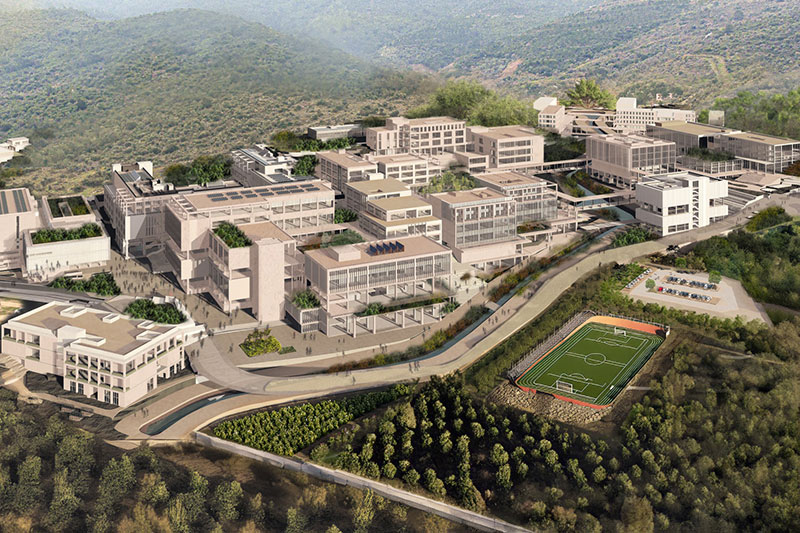
IZMIR UNIVERSITY OF ECONOMICS GÜZELBAHÇE CAMPUS
DetailsGLOBAL CAREER
As Izmir University of Economics transforms into a world-class university, it also raises successful young people with global competence.
More..CONTRIBUTION TO SCIENCE
Izmir University of Economics produces qualified knowledge and competent technologies.
More..VALUING PEOPLE
Izmir University of Economics sees producing social benefit as its reason for existence.
More..
You are one step ahead with your graduate education at Izmir University of Economics.